
LWVC Advocacy Wrap-Up 2026
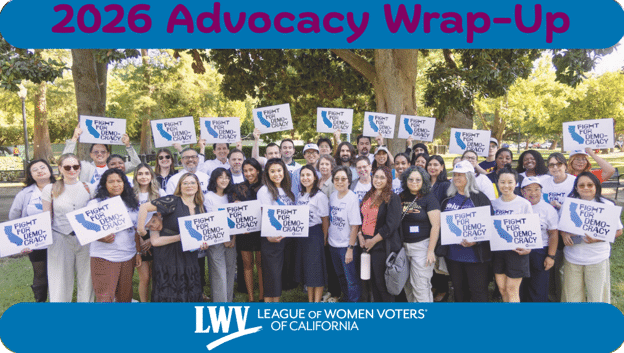
In 2026, California faced mounting federal threats to our democracy, efforts to roll back voting rights, escalating attacks on immigrant communities, and growing concerns about intimidation at the polls. The League of Women Voters of California responded forcefully and effectively on multiple fronts by advancing legislation, defending voting rights in court, supporting local Leagues, and engaging voters on consequential ballot measures.
The League’s defining legislative victory was the California Voting Rights Act of 2026, a two-bill package that responds directly to the erosion of federal Voting Rights Act voting rights by strengthening California’s state protections against voter suppression and barriers to language access. Other major victories include helping pass the No Kings Act to hold federal officers accountable for constitutional rights violations, achieving greater transparency in immigration detention and protections against federal immigration enforcement abuses, and successfully moving legislation that confronts corporations’ historical ties to slavery as part of broader reparations efforts. Our advocacy extended to election safeguards, independent redistricting, criminal justice and racial justice reform, campaign finance transparency, affordable housing, and climate and water protections, while opposing efforts to undermine voting rights or weaken public accountability.
This wrap-up offers highlights of the second year of the 2025-2026 session. You can read about the first year in our 2025 Advocacy Wrap-Up. As always, detailed letters relating to all the bills on which we took action may be found in our Bill Status Report. And please sign up to receive our monthly e-news to keep you abreast of developments.
ADVOCACY HIGHLIGHTS: PROGRESS, SETBACKS, AND WHAT COMES NEXT
Protecting Democracy – The Wins
California took a major step toward protecting voting rights in 2026 by strengthening state law in the face of the Supreme Court’s relentless assault on federal voting rights protections. As co-sponsors working through the California Democracy Partnership, we helped pass two bills that together make up the California Voting Rights Act of 2026:
- SB 1164 (Cervantes) expands California’s protections against voter suppression and vote dilution, giving voters stronger tools to challenge election rules and systems that unfairly burden racial and language-minority communities or weaken their ability to elect candidates of their choice. It establishes state law protections against discriminatory effects, even without proof of discriminatory intent, and provides a path to seek remedies in state court to replace what once was available under federal laws.
- SB 1360 (Cervantes) strengthens language access by preserving existing federal language assistance requirements in state law and establishing a future state process for identifying additional language coverage obligations. Starting with a determination due by December 15, 2031, the Secretary of State must identify counties meeting specified language-minority thresholds. Voters should not lose access to election materials because federal protections are weakened.
Independent Redistricting in San Bernardino County. SB 1414 (Reyes) creates a 14-member citizens redistricting commission to draw San Bernardino County supervisorial districts, subject to an appropriation by the Legislature. Moving map drawing power out of the hands of the officials whose districts are at stake allows an independent commission, rather than politicians, to draw district lines. This is an important safeguard against conflicts of interest. LWVC co-sponsored the bill with California Common Cause and Inland Empire United.
Safeguarding California’s Elections. As threats to California’s elections intensified, the League responded with urgency. We championed legislation to defend election systems from interference and protect voters from intimidation at the polls.
- SB 73 (Cervantes) strengthens protections against improper law enforcement interference with California’s elections, including unauthorized access to or seizure of voter lists and election materials. The danger became concrete in February 2026, when the Riverside County Sheriff, who was then running for a gubernatorial nomination, seized more than 650,000 ballots from the November 2025 special election. California already has rigorous systems for testing and securing voting equipment, but those protections can be undermined when law enforcement interferes with election administration. SB 73 establishes additional safeguards and requires Attorney General guidance on law enforcement requests involving locations where ballots are present. Governor Newsom signed the bill in time for the November election.
- AB 1664 (Jackson) builds on SB 73 by requiring local election officials to notify the Secretary of State and Attorney General about warrants, subpoenas, and investigations involving election records or voting technology. It also gives state officials a way to challenge improper demands in court. Early notification is critical because it allows the state to respond before interference disrupts an election. These provisions remain in effect through 2029.
- SB 884 (Umberg), the Protect Our Polls Act, focuses on voters themselves. For elections from 2026 through 2029, it prohibits law enforcement arrests within 200 feet of polling places on Election Day while polls are open, with specified exceptions. It also allows counties to expand existing restrictions on electioneering to 200 feet around polling places, elections offices, and ballot drop-off locations, permits election officials to extend polling hours when violations disrupt voting, and requires ballot drop-off locations to open at least 30 days before Election Day, giving voters more time to return their ballots. We worked alongside Senator Umberg to advance these protections in time for the November election. Hear our remarks from the press conference earlier this year.
In-Person Vote-by-Mail Return. Programs like “Sign, Scan, and Go” give voters a convenient way to cast ballots they completed at home. At participating voting locations, voters can check in, sign the roster, and cast their ballots without a vote-by-mail identification envelope, either scanning them on site or depositing them for later counting. This approach reduces the risk of ballot rejection due to signature problems, makes ballot processing more efficient, and helps more ballots get counted on election night. We backed SB 1420 (Richardson), which requires the Secretary of State to establish uniform procedures for this voting option and expand voter education about it, including information in the official state Voter Information Guide.
More Accessible Ballot Curing Process. Missing or nonmatching signatures remain a major reason vote-by-mail ballots go uncounted, particularly among younger and first-time voters. These are often fixable errors, not reasons an eligible voter should lose their voice. AB 2604 (Berman), which we worked to advance, requires the Secretary of State to make an electronic signature curing system available to county elections officials. Giving voters a convenient way to correct mistakes will mean more valid ballots are counted.
Protecting Democracy – Bills We Opposed
Stop Faulty Voter Registration Purges. SB 1310 (Choi) would have canceled voter registrations based on unreliable juror records that could be outdated, inaccurate, and collected under different standards. Voters could lose their registrations before receiving notice or a chance to correct mistakes, with no requirement for notice in their preferred language. These inadequate safeguards threatened to disenfranchise eligible voters. The League opposed the bill in the Senate Elections Committee, then organized coalition opposition when it moved to the next committee. Deputy Director Dora Rose testified against the bill, helping to kill it.
Protecting Democracy – Notable Losses
Primary Election Reform. Our co-sponsored bill, AB 868 (Carrillo), would have ensured that the final choice for nonpartisan county offices is made in November, when more voters participate, rather than allowing contests to be decided in low-turnout primaries. Although the bill did not advance, we are planning to bring it back in 2027. Over the summer, we partnered with Common Cause California to host five regional webinars explaining the need for reform and building local support. We thank the San Luis Obispo, Greater LA, San Bernardino County, Fresno, and other participating Leagues for helping moderate and promote these events. Watch the recorded webinar and learn more about our coalition efforts.
Transparency and Impartiality for Voters. SB 1225 (Niello) would have shifted responsibility for writing titles, summaries, and ballot labels for proposed statewide ballot measures from the Attorney General to the Legislative Analyst’s Office (LAO). The LAO has a clear history of carrying out its work in a fair manner insulated from political pressure. LWVC has advocated for this change for the past few legislative sessions because voters deserve clarity, transparency, and fairness in the initiative and referendum process. Unfortunately, SB 1225 failed once again in Senate Appropriations.
Online Voter Registration. AB 1116 (Berman) would have allowed eligible Californians without a driver’s license or state ID card to register fully online using the last four digits of their Social Security number and an electronic signature. We have long championed California’s New Motor Voter registration system, including serving on its task force. Despite significant gains made through that system, approximately 4 million eligible Californians remain unregistered. AB 1116 would have helped close a longstanding barrier in access to online voter registration, a critical step in addressing the state’s voter participation gap. We are disappointed in the Governor’s veto.
Government Accountability, Transparency & Money in Politics – The Wins
Local Government Nondisclosure Agreements. Local officials cannot govern effectively when nondisclosure agreements (NDAs) prevent them from sharing important information about public business with their colleagues. We backed SB 994 (Cabaldon), which prohibits local officials and staff from entering into NDAs that block sharing information with fellow governing body members or the officials they serve. The new law helps prevent secrecy within local government and ensures officials have the information they need to make responsible decisions and remain accountable to the public.
Print Ads DISCLOSE Act. SB 900 (McNerney) will make disclosures on ballot measure and independent expenditure print advertisements easier to read. By shortening committee and contributor names, improving formatting to make top funders clearer, and requiring disclosures identifying the top three contributors to appear on the outside of mailers, voters will have clearer information about who is funding political advertising.
Keep Large Campaign Expenses Transparent. The public has the right to know how campaign money is spent, no matter when in the election cycle expenditures occur. We advocated for AB 2255 (Pellerin) to require greater disclosure of large campaign expenditures, including their purpose and certain personal or professional relationships between recipients and candidates, even if the candidate will not appear on the next ballot.
Behested Payment Reporting. Behested payments are made at an elected official’s request, often for charitable or governmental purposes. The public deserves to know who pays, who receives the money, and whether the payer has business before the government official’s agency. We pressed for AB 775 (Fong), which strengthens transparency through electronic reporting to the Fair Political Practices Commission or public posting by local agencies, along with disclosures of relationships among donors, recipients, and officials.
Protect Public Comments. Public comments give constituents a voice in decisions that shape their lives. But that process is undermined when organized interests manufacture public support or opposition through bots, AI-generated personas, or paid campaigns that submit comments in the names of real people without their consent. We supported AB 1736 (Pellerin) which closes an important loophole by extending existing prohibitions against these deceptive lobbying practices to the organizations that employ lobbyists.
Notable Losses
Improve FPPC Travel Reporting. Existing law requires certain nonprofits that pay for elected officials’ travel to disclose information to the Fair Political Practices Commission, but only when travel expenses exceed one-third of their total expenditures. This threshold has effectively stifled reporting. We called for passage of AB 1788 (Boerner), the Travel Transparency Act, to strengthen disclosure requirements and improve transparency around who pays for elected officials’ travel. Unfortunately, the bill failed in the Assembly.
Public Access. A bipartisan approach to open government and public access to the legislative process failed before being assigned to any policy committee. AB 2063 (Wallis) and AB 2557 (Bauer-Kahan), the Public Letters Act, would have required bill position letters, such as those written by the LWVC, submitted through the Legislature’s internet portal to be made publicly available on the California Legislative Information website. We are disappointed that neither bill advanced and hope the Legislature revisits this straightforward transparency reform next session.
Criminal Justice
This session brought important advances in protections against excessive force, jail oversight, and access to legal counsel, alongside a significant setback for our co-sponsored bill to strengthen the Racial Justice Act.
Stop Excessive Police Force. Flash-bang grenades can cause serious burns, hearing loss, and other significant injuries, particularly when deployed in crowds or near bystanders. Existing state law does not contain safeguards for such devices. We urged passage of SB 937 (Gonzalez) to extend restrictions on crowd-control weapons to flash-bang grenades and limit the use of explosive breaching charges in law enforcement operations.
Promote Jail Governance Accountability. AB 2257 (Hart) allows county boards of supervisors to establish a jail administrator position and confirm or deny the sheriff’s nominee for that role. This gives county supervisors – who fund jail operations and bear significant fiscal and legal exposure when things go wrong – a practical tool to promote accountability in jail governance.
Fair Representation Act. Those who are charged with a crime have the right to effective legal counsel under the U.S. and California Constitutions. Indigent defense means that the government is required to provide and pay for attorneys for people who cannot afford their own private counsel. These requirements make up a more just and effective criminal justice system. We strongly supported AB 690 (Schultz) because it establishes standards for indigent defense contracts beginning in 2028, including limits on flat fee arrangements in the most serious cases. These safeguards can help ensure defense attorneys have the time and resources to provide effective representation.
Protect Mental Health Diversion. We opposed SB 1373 (Grove) and helped stop it from advancing late in session. The bill would have limited the use of mental health diversion – court-supervised intervention that improves public safety while connecting Californians with the care they need. Mental health conditions and substance use disorders are public health issues, not crimes. We opposed the bill for its failure to support treatment over entry into the criminal justice system.
Notable Criminal Justice Losses
Improve Disparity Claims Under the RJA. Unfortunately, the state Assembly failed to pass our co-sponsored bill, AB 1958 (Kalra), following last-minute intensive lobbying of legislators by law enforcement groups. The bill would have improved procedures for establishing disparity claims under the RJA, reduced unnecessary delays, and provided clearer guidance to courts. We are concerned about the strong influence that the law enforcement opposition was able to wield, and intend to return to these important accountability reforms in 2027.
Reparations
Establishing Accountability & Truth. AB 2599 (Bryan), the Truth in Disclosure Act, takes an important step toward confronting the legacy of slavery by requiring certain large businesses operating in California, with more than $100 million in annual worldwide revenue, to examine their records and disclose whether they or their predecessors participated in or profited from slavery, slaveholding, or the slave trade. These disclosures will become public once the program is funded and implemented. Acknowledging these injustices cannot undo the lasting harm inflicted on Black Americans or erase persistent racial disparities. But documenting this history is essential to understanding how slavery contributed to the success of businesses and institutions far beyond large plantations, to holding those institutions accountable, and to securing reparations. LWVC worked to advance this legislation and will continue to partner with organizations leading reparations efforts in California.
To get involved in League education and advocacy, join our new Reparations Advocacy Interest Group (RAIG).
Civil Rights, Immigration & Federal Accountability
The No Kings Act. Ongoing federal overreach and violations of civil rights and liberties demand accountability, which is why we championed SB 747 (Wiener). The law gives Californians a new path to sue federal officers, including immigration agents, for violating federal constitutional rights. SB 747 reinforces the principle that no official, federal or state, is above the law.
Detention Facility Transparency Act. Reports of deaths, medical neglect, sexual abuse, and other atrocities in immigration detention facilities have raised serious questions about the conduct of those running the facilities. We fought for SB 423 (Gonzalez) to bring more public scrutiny to these conditions. The legislation makes specified records held by state and local agencies concerning incidents at private detention facilities accessible under the California Public Records Act, including certain communications and law enforcement records. The new law will help prevent important information about these incidents from being hidden behind a wall of secrecy.
While we welcome the passage of SB 423, we are deeply disappointed by the veto of SB 1105 (Pérez), the Protect California Rights Act. California’s law enforcement resources should serve our communities by protecting public safety, equal justice, and constitutional rights, not advancing a federal enforcement agenda that treats entire communities as suspect. SB 1105 would have prohibited state and local law enforcement agreements that facilitate racial or identity profiling, criminalization of speech, or use of unauthorized weapons of war. It also would have prevented California from granting federal officers broad arrest powers beyond their federal jurisdiction.
Preventing Conflicts of Interest for Peace Officers. Crime prevention and the promotion of public safety should be the primary roles of state and local law enforcement. However, nothing in current state law prohibits local and state peace officers from moonlighting as ICE or deportation agents. AB 1537 (Bryan), the No Side Jobs for ICE Act, which LWVC advocated for, would have closed that gap. The bill would have barred certain peace officers from taking secondary jobs involving arrests, detention, transportation, or deportation under federal immigration law. Governor Newsom’s veto sets back important efforts to protect our communities.
Immigration Resources. True democracy means everyone can live with dignity and safety. As communities across California face rampant intimidation and threats from federal immigration agents, the League continues to stand up for immigrant rights in the legislature and provide resources to local Leagues to protect their communities.
You can learn more about what the League is doing on immigration issues nationally as well as find helpful resources for your communities by visiting our website here.
Housing
Modernizing Infill Infrastructure Grant Program. An important housing and climate victory this year was the passage of SB 772 (Cabaldon), sponsored by Prosperity California. The new law modernizes California’s Infill Infrastructure Grant Program, expanding opportunities for affordable housing development, particularly in smaller cities and towns where inadequate infrastructure can be a major barrier to building new homes. By broadening eligibility for funding and giving greater consideration to walkable neighborhoods with access to jobs, transit, and essential services, SB 772 will help communities build much needed housing while supporting thriving local economies and California’s climate goals.
Climate, Air Quality & Water
Our climate and natural resources efforts in 2026 centered on clean water, healthy air, and energy affordability. LWVC helped secure several wins this session. The most notable were:
Remove Barriers to Clean Energy. Heat pumps can lower energy use, reduce indoor air pollution, and help households move away from fossil fuels. However, complicated permitting can discourage installation. LWVC advocated for SB 222 (Wiener), the Heat Pump Access Act, which streamlines permitting and inspections for qualifying residential heat-pump systems, including options for remote inspections and automated online permits. These practical changes can make cleaner, more efficient home heating and cooling easier to install.
Protecting Utility Customers as Data Centers Expand. The rapid growth of AI is driving proposals for large data centers, with substantial demands on California’s electric grid. We supported SB 886 (Padilla), the California Technology Innovation and Ratepayer Protection Act, because households and other businesses should not have to absorb the costs of serving these new facilities. The law requires the Public Utilities Commission to establish or update tariffs and rules for certain large electricity customers, considering costs and risks to other ratepayers. As electricity demand grows, protecting affordability needs to be part of the equation.
Other climate and water wins include:
Community Air Quality Response. Hydrogen sulfide is a highly toxic gas, and chronic exposure can negatively impact public health. Tijuana River Valley and Salton Sea areas have shown exceedances of the state hydrogen sulfide standard. The state’s hydrogen sulfide standard dates to 1969 and was last reviewed in 1984, raising questions about whether it adequately protects public health. SB 58 (Padilla) requires the California Air Resources Board to develop a framework to help communities prepare for and respond to hydrogen sulfide exposure, supported by updated health guidance.
Protect Workers from Pollution. SB 1046 (Blakespear) addresses hazardous pollution crossing the California-Mexico border that puts outdoor workers, including lifeguards and park rangers in the Tijuana River Valley, at risk. The California Division of Occupational Safety and Health (CalOSHA) will now be required to develop workplace protections, including standards for training, protective equipment, and reporting when workers face these exposures.
Climate Bond Fund Distribution. AB 35 (Alvarez), the Proposition 4 Implementation Acceleration Act, streamlines the distribution of Proposition 4 (2024) climate bond funds by allowing agencies to adopt grant guidelines outside the Administrative Procedure Act process, while retaining public notice, comment, and transparency requirements.
Problematic Water Bill Stopped in Committee. LWVC joined a coalition of water conservation groups, environmental justice organizations, and Indigenous tribes to oppose AB 2215 (Calderon). The bill would have extended six State Water Project water-right permit deadlines to 2046, bypassing the State Water Board’s normal review process, including environmental review under CEQA. These permits are also critical to the controversial Delta Conveyance Project, and the bill would have helped clear the way for that project without the usual scrutiny. Working with our coalition partners, we helped stop AB 2215 in the Senate, preserving important safeguards for California’s water resources.
Clean Water Protections Suffer Setback. A notable loss occurred when SB 601 (Allen), the Right to Clean Water Act, stalled. The bill would have restored protections for streams and wetlands left vulnerable by federal Clean Water Act rollbacks and given the State Water Board clearer authority to protect those waters.
BEYOND BILLS
Our advocacy goes beyond passing bills. We work with public agencies on implementation, defend voting rights in court, help local Leagues and voters navigate election rules, and respond with partners when new threats arise. The following are a few examples.
Litigation
Our advocacy in 2026 also took us into the courts, where we fought to protect voting rights, voter privacy, and California’s authority to administer its own elections.
In United States v. Weber, the League intervened to fight the Trump administration’s sweeping demand for California’s complete voter file, including sensitive personal information such as driver’s license and Social Security numbers. Access to that data would have invaded the privacy of all Californians and allowed federal officials to compare California’s voter rolls against flawed federal citizenship databases in their hunt for alleged noncitizen voters. A federal judge dismissed the Justice Department’s lawsuit in January, although the administration appealed. (The Ninth Circuit decision is still pending as of publication of this Wrap-Up but is expected soon).
The danger of that effort has become increasingly clear. In October, the DOJ demanded that California set aside ballots from more than 20,000 voters flagged as possible noncitizens through error-prone data matching similar to methods long used by election conspiracy theorists. When California refused, DOJ sued and threatened election officials with prosecution. Meanwhile, highly publicized federal raids accompanied charges against just 28 people in a state with 23 million registered voters, only 21 of whom were even accused of voting.
Far from establishing widespread fraud, these escalating actions threaten to intimidate eligible voters and demonstrate why the League’s fight to protect voter data and defend California’s election administration is so important.
In Issa v. Weber, we intervened to defend California’s law allowing mail ballots postmarked by Election Day to be counted if they arrive within seven days of Election Day. Congressman Issa sought to eliminate this protection, potentially disenfranchising thousands of voters whose ballots were mailed on time but delayed in delivery. Following a June U.S. Supreme Court ruling upholding states’ authority to count timely cast ballots received after Election Day, Issa voluntarily dismissed his lawsuit. California voters have therefore retained this critical safeguard against mail delays.
In Cervantes v. Bianco, the League and Common Cause filed an amicus brief challenging Riverside County Sheriff Chad Bianco’s extraordinary seizure of nearly 650,000 ballots. The seizure followed years of pressure from election conspiracy groups promoting unsubstantiated claims of rigged vote counts and manipulated voting machines. In September, the California Supreme Court unanimously ruled the seizure unlawful and ordered the ballots returned, reaffirming that sheriffs cannot take control of election materials or conduct investigations outside the procedures established by state law.
In California v. Shasta County, we joined the LWV of Redding Area and other voting rights organizations in challenging Measure B, a sweeping overhaul of county elections promoted by election deniers spreading unfounded claims about voting machines and election fraud. The measure would have required photo ID to register and vote, virtually eliminated mail and early voting, and mandated hand counting of ballots. A court blocked the measure before the November election, protecting voters from these new barriers and reaffirming that counties cannot disregard statewide election laws.
Ballot Measures
The League devoted significant work to researching the November 2026 statewide ballot measures and explaining our recommendations to voters. We produced ballot measure recommendations that were published on Vote with the League, along with a deeper dive into each measure.
LWVC also co-chaired two campaign committees: Yes on Proposition 4 (to reduce the influence of wealthy donors and give everyday Californians a stronger voice in elections), and No on Proposition 39 (to protect voting rights and prevent new barriers that could keep eligible voters from casting their ballots and having their votes counted). The LWVC helped guide campaign strategy, coordinated coalition partners, developed messaging, and engaged voters through public events, social media, and extensive media outreach.
Voter Protection
Voter protection is both practical assistance and ongoing advocacy. We provide voting information through our hotline (888) 870-VOTE (8683) and cavotes.org, bring together Know Your Rights resources, and help voters understand how to cast a ballot that will count. We also monitor threats to voting access with partners and work with state and county election officials to resolve problems when they arise.
LOOKING FORWARD
As this two-year legislative cycle ends, we are already preparing for 2027. With all 80 Assembly seats and 20 state Senate seats on the ballot this November, the Legislature will look different next year. Meanwhile, the Legislative Analyst’s Office projects continued budget challenges in the years ahead.
Whatever the political and budget environment, important work remains unfinished. We are already planning to reintroduce legislation to reform county primary elections and strengthen the Racial Justice Act, building on the work we did to advance both bills this year.
Don’t forget about our Advocacy Interest Groups! The groups span many policy topics, including Criminal Justice, Healthcare, Housing and Homelessness, Reparations, Open Government, Climate Change, and Water – check the list to join one. They are a great place to become educated in issue areas.
A WORD OF THANKS
None of this would be possible without the tireless work of our advocacy team and grassroots leaders. Our work depends on volunteers, members, and local Leagues who turn policy goals into action. As we enter 2027, we will keep defending the right to vote, pushing for accountable government, and building a democracy in which everyone can participate. Thank you for making it all possible.
CONTRIBUTE TO OUR WORK
The threats to our democracy are not letting up. From federal interference in California elections to attacks on voting rights and accountable government, the challenges ahead demand a strong response. The League is fighting back in the courts, at the Capitol, and in communities across California. But we cannot do it without you. Yes, the League is a grassroots organization; that’s part of the strength of the organization. But contributions help us respond quickly, defend voters, and stand up for democracy when it matters most.